 Knowledge
Working Agreements
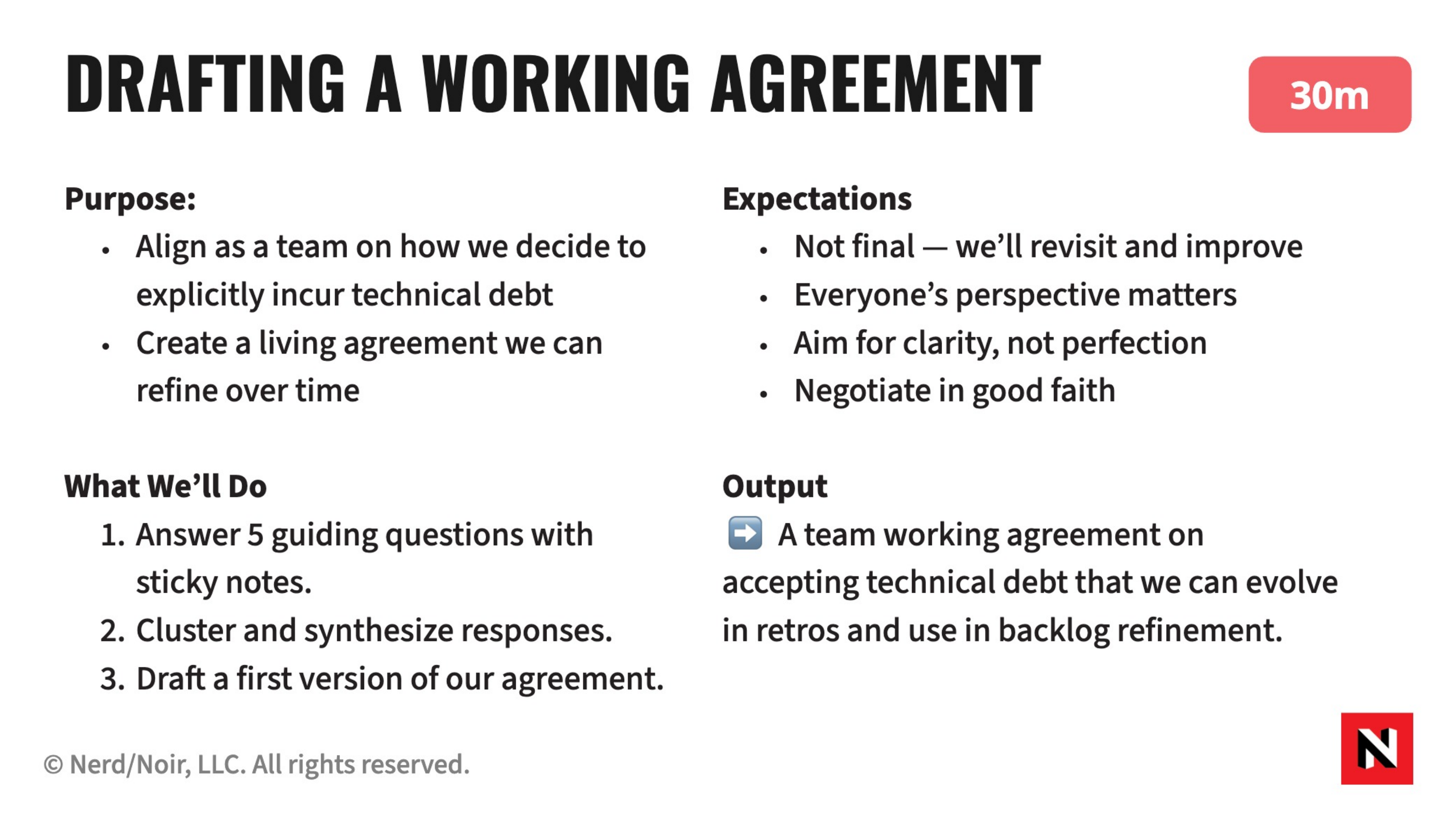
Working agreements are explicit, team-authored rules about how a group collaborates, makes decisions, and resolves conflict. Every team has norms; the question is whether those norms are visible or whether they exist only as unspoken assumptions that surface as friction when someone violates them. Implicit norms drift. A team that never discussed how it handles disagreements will discover its conflict resolution process in the middle of the worst possible moment to discover it. Making agreements explicit forces the conversation early, when stakes are low and options are open.
We use working agreements as a required component of Framing. When a team builds its frame, working agreements are where the “how we work together” gets codified alongside the “what we’re trying to accomplish.” They also feed directly into a team’s Team API, making collaboration expectations visible to other teams. The best working agreements are specific enough to be testable (“we respond to Slack messages within 4 hours during business hours”) rather than aspirational (“we communicate well”). They should be revisited regularly; a working agreement that nobody references is either so internalized it can be retired, or so ignored it needs renegotiation.
What to Include
- Meeting rhythms and formats — which meetings exist, who attends, what each meeting produces
- Decision-making authority — who decides what, when consensus is required vs. when someone has final call
- Communication preferences — response time expectations, preferred channels, async vs. sync defaults
- Definition of done — what “finished” means for the team’s work
- Conflict resolution — how disagreements are surfaced and resolved before they fester
- Escalation paths — when and how to escalate blockers or disagreements outside the team
Named Patterns
Some agreements show up often enough to have names. These emerged from immersive learning engagements where teams had to build trust and shared practice fast:
- No Invisible Work — all work is on the board, whether planned or not. If it is not on the kanban, it does not exist. This surfaces hidden work and makes load visible.
- 100% Pairing — the team defaults to pair programming for all production work. Get good at pairing by doing it all the time. Solo work is the exception, not the rule.
- Cameras On, Mics Open — for remote teams, default to video on and microphones unmuted during collaboration sessions. Simulate the openness of sitting next to each other.
- BRB Protocol — if you need to step away, say “BRB” in the chat. The team acknowledges and continues without interrupting flow. Small courtesy, big impact on focus.
- Bring It Into the Room — when external interrupts arrive (production incidents, stakeholder requests), don’t silently context-switch. Bring the interruption to the team so everyone can decide together whether to absorb it or defer it. Turns disruptions into learning opportunities.
Resources
- Framing — working agreements are a required frame component
- Team API — externalizes working agreements for cross-team collaboration
- Continuous Planning Playbook — working agreements support the recurring events that keep teams in rhythm