 Knowledge
Learning Pyramid
The fastest way to forget something is to sit through a presentation about it. The fastest way to learn it is to teach it to someone else.
People remember almost nothing from lectures. Edgar Dale’s “Cone of Experience” puts approximate numbers to what practitioners already feel: ~5% retention from listening, ~10% from reading, ~90% from teaching someone else. The specific figures are contested, but nobody who has watched a team sit through a training deck and change zero behavior doubts the gradient. Passive consumption is where knowledge goes to die; participation is where it takes root.
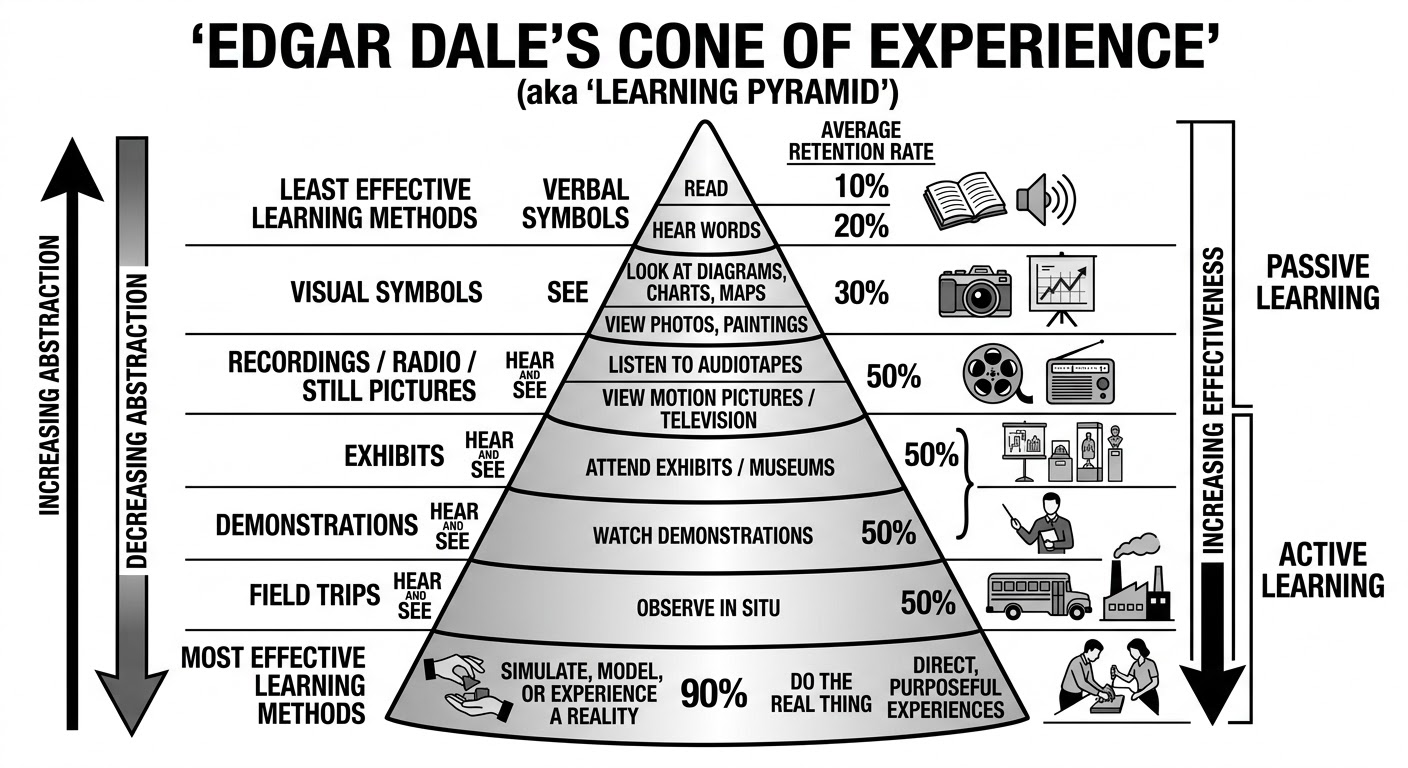
This is why we stopped running lunch-and-learns and started running coding dojos. A team that pairs on a real problem for an afternoon retains more than a team that watches a 10-part video series over a month. The pyramid pairs naturally with the Experiential Learning Cycle; Kolb’s cycle explains how active learning works, the pyramid shows how much more it works. When we design a Shook’s Model-style intervention, we’re betting on the same principle: don’t explain the new way, make people live it.
Resources
- Edgar Dale, “Audio-Visual Methods in Teaching” (Dryden Press, 1946) — the original Cone of Experience
- Wikipedia: Learning Pyramid — overview of the model and its contested retention figures
- Experiential Learning Cycle — the complementary model for how active learning works
- Shook’s Model — change behavior first; the pyramid explains why that approach retains