 Knowledge
Experiential Learning Cycle
People don't learn by being told; they learn by doing something, reflecting on what happened, and trying again. Skip any of those steps and you get training theater.
Many organizations teach first and hope people do something with it. Slide decks, training sessions, new principles on the wiki or a screensaver. Then they wonder why nothing changes. David Kolb formalized what practitioners already sense: learning starts with doing, not listening.
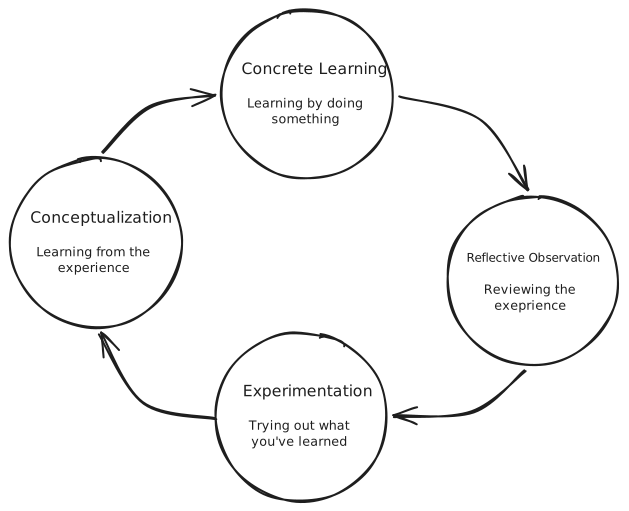
The cycle has four stages — Concrete Experience, Reflective Observation, Abstract Conceptualization, and Active Experimentation — each feeding the next. A team runs a sprint, then holds a retrospective to name what went well and what didn’t. They identify a pattern and design an experiment for the next iteration. Skip any stage and learning degrades; skip reflection and you repeat mistakes, skip experimentation and insights stay theoretical.
This is why we structure workshops and change initiatives around experience first, theory second. We lead with an exercise that surfaces the tension: a Gemba Walk that makes invisible work visible, or a simulation that exposes bottlenecks. Then we use reflection to let the group name what they saw. Shook’s Model runs on the same insight — change behavior first and thinking follows. Kolb gives you the mechanism for why that works: each loop through the cycle builds conviction that the old way doesn’t hold up.
Psychological safety matters here; honest reflection only happens when people aren’t punished for surfacing uncomfortable truths. And the “active experimentation” stage is where quick wins live — small, low-risk changes that prove new thinking works. Get the cycle spinning and teams stop waiting for permission to learn.
Resources
- David Kolb, “Experiential Learning: Experience as the Source of Learning and Development” (Prentice Hall, 1984)
- Shook’s Model — the complementary principle: change behavior to change thinking
- Psychological Safety — the precondition for honest reflective observation
- Gemba Walks — a practice that generates concrete experience
- Quick Wins — the active experimentation stage in practice
- Learning Pyramid — evidence that active, participatory methods dramatically outperform passive instruction
- SECI Model — extends individual learning to organizational knowledge creation across tacit and explicit dimensions