 Knowledge
Outcome-Based Roadmap
An Outcome-Based Roadmap replaces the traditional feature-timeline Gantt chart with a Now/Next/Later format where each column contains outcomes, not features. The structure forces teams to articulate why work matters before specifying what to build.
Header: Product Team, Team Name, Last Updated Date.
Columns: Now (current quarter, multiple slots), Next (upcoming quarter), Later (“on our radar”). Each Now column carries a status indicator: On Track, At Risk, or Blocked.
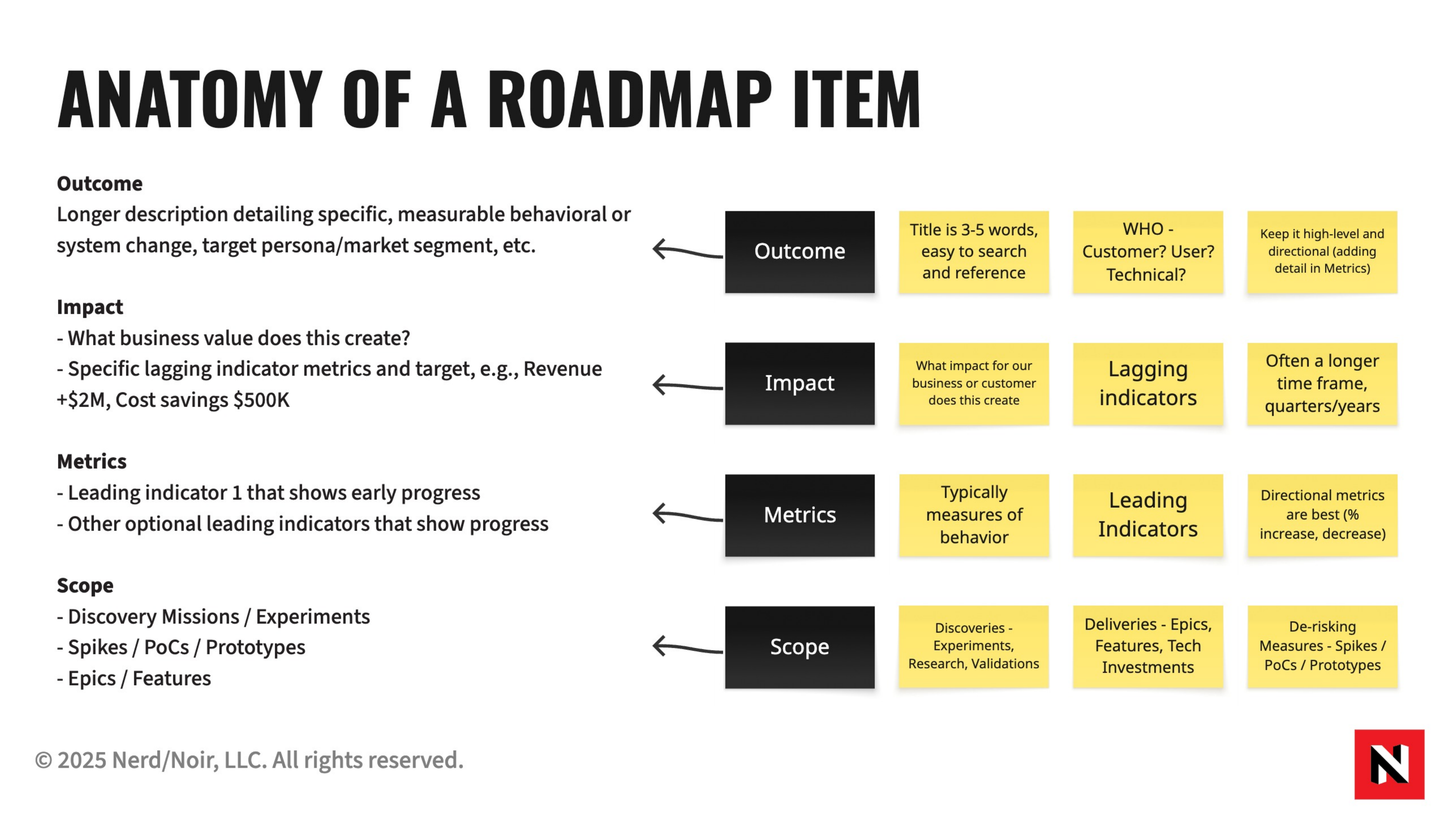
Rows for each outcome:
| Row | What It Captures |
|---|---|
| Outcome | The behavioral or system change (3-5 word title + description). See Outcome Template for the full anatomy. |
| Impact | The “So what?!” with lagging indicators (e.g., “$180K quarterly revenue increase”) |
| Metrics | Leading indicators that show early progress (e.g., “Search-to-cart time, 35% decrease”) |
| Scope | Bets: discoveries (experiments, research), deliveries (epics, features), and de-risking measures (spikes, PoCs) |
The format works because “Now” carries the most detail and commitment, “Next” is directional with less specificity, and “Later” is exploratory. As time passes, “Next” becomes “Now” on roughly a quarterly cadence, with bi-weekly check-ins keeping the roadmap alive between major updates. Scope flexes within fixed time horizons; the commitment is to delivering valuable outcomes each quarter, not completing a predefined feature list.
We use this format in the Outcome-Based Roadmaps workshop, where the Product Logic Model provides the intellectual backbone and the NOICE framework helps teams rank which outcomes land in “Now.”
Resources
- Outcome Template — the anatomy of a single outcome entry on this roadmap
- Product Logic Model — the causal chain that structures each outcome’s rows
- Roadmapping — roadmapping as an ongoing practice, not a quarterly deliverable
- Outcome-Based Roadmaps — where teams build these roadmaps hands-on