 Knowledge
Balancing Impacts
If you're only optimizing for one of desirability, viability, or feasibility, you're building a product that will eventually collapse under its own imbalance.
Impacts are the ultimate business and customer value created. They answer “why does what I’m doing matter?” and are quantifiable benefits that justify investment, measured by lagging indicators that take time to materialize. In the Product Logic Model, impacts sit at the top of the causal chain.
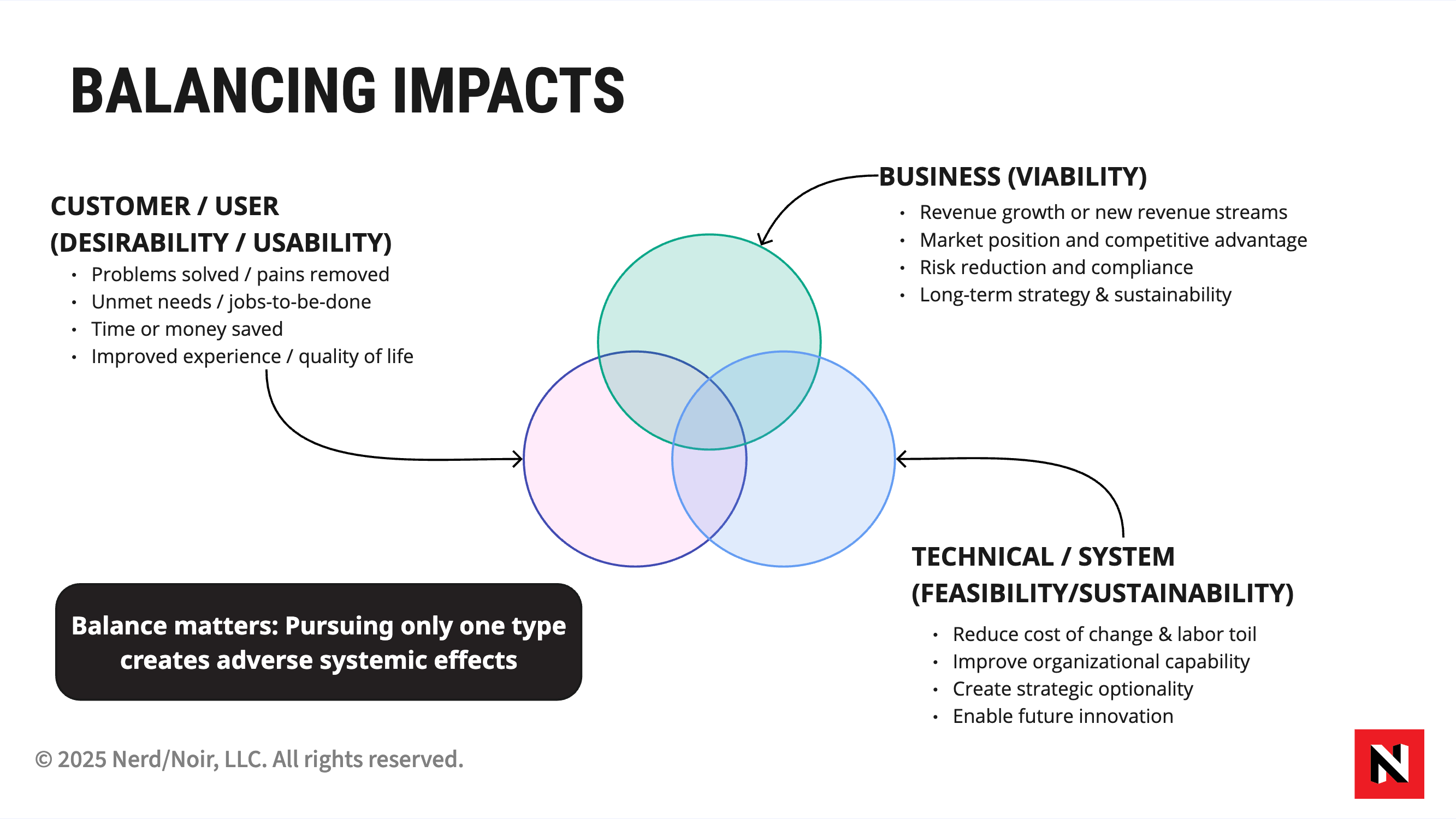
The three-lens model above draws on the Desirability/Viability/Feasibility framework from IDEO’s design thinking tradition, adapted here for outcome-based product practice. Pursuing only one type creates adverse systemic effects.
Customer/User (Desirability)
- Problems solved, pains removed
- Unmet needs and jobs-to-be-done addressed
- Time or money saved
- Improved experience and quality of life
A product that ignores desirability builds something nobody wants. But desirability alone doesn’t sustain a business.
Business (Viability)
- Revenue growth or new revenue streams
- Market position and competitive advantage
- Risk reduction and compliance
- Long-term strategy and sustainability
A product that optimizes only for business viability extracts value without creating it. Short-term revenue at the expense of user trust is a lagging indicator of churn.
Technical/System (Feasibility)
- Reduced cost of change and labor toil
- Improved organizational capability
- Strategic optionality created
- Future innovation enabled
A product that over-indexes on technical feasibility builds elegant systems nobody needs. But ignoring feasibility means the cost of every future change grows until the team can barely move.
The Balance
The overlap of all three is where sustainable products live. A business-only focus burns out users; a technical-only focus builds for builders; a user-only focus can’t sustain itself. The three outcome types (User, Customer, Technical) map naturally to these impact categories, which is why balancing outcome types on an outcome-based roadmap matters.
Common anti-patterns include confusing impacts with outcomes, expecting immediate results from lagging indicators, failing to measure outcomes that connect to impact, and over-indexing on business impacts alone.
Resources
- Product Logic Model — the parent framework
- Three Outcome Types — User, Customer, and Technical outcomes that drive these impacts
- Leading and Lagging Indicators — impacts are measured by lagging indicators
- Outcome-Based Roadmaps — where teams practice balancing impacts across their roadmaps