 Knowledge
Impact-Outcome Model
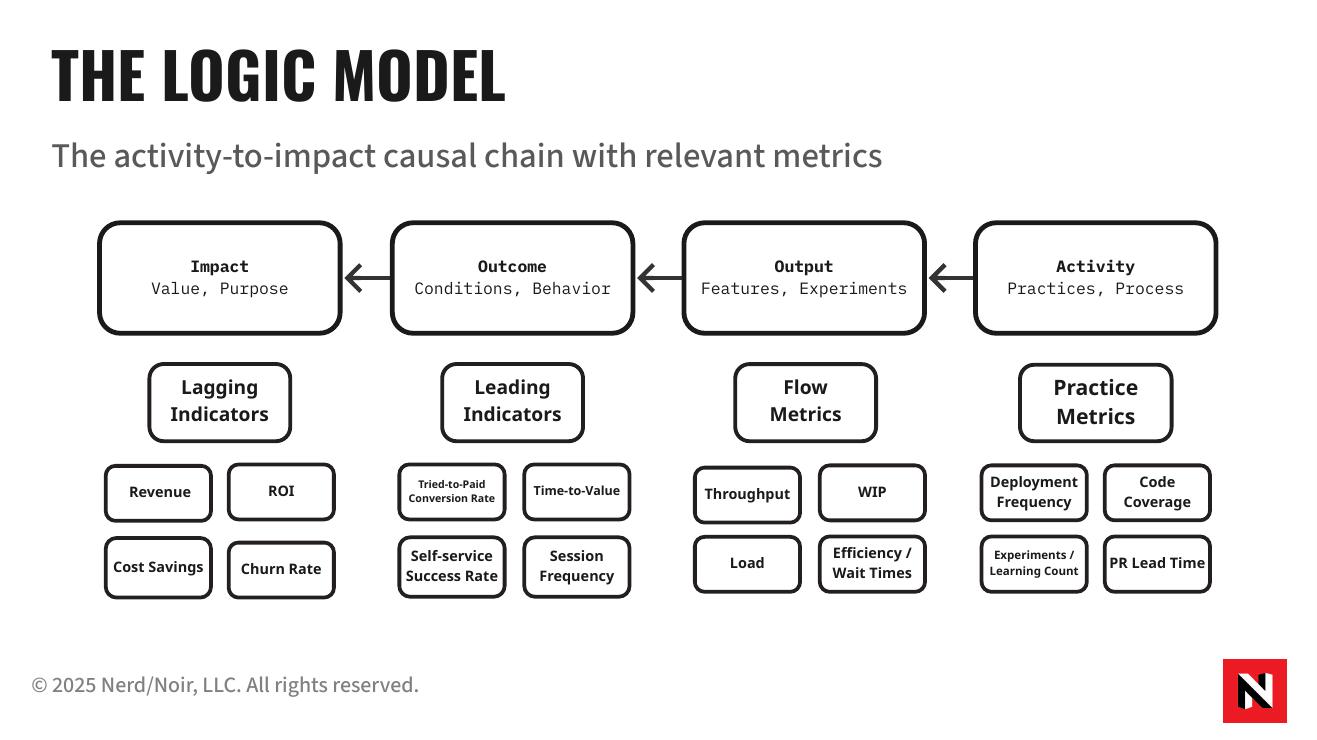
If you can't trace a feature back to a behavior change and a business result, you're just shipping and hoping. The Impact-Outcome Model makes that causal chain explicit.
The Impact-Outcome Model (aka Logic Model) is a causal chain that connects team activities to business impact through four levels: Activity, Output, Outcome, and Impact. This model draws on the logic model tradition and is informed by Joshua Seiden and Jeff Gothelf’s Outcomes Over Outputs (Sense & Respond Press, 2019). What follows is our adaptation for consulting and product practice.
Each level has its own set of metrics or KPs, and the chain only works when every link aligns. Break the link between Output and Outcome and you fall into the Output-Activity Trap, where teams stay busy shipping features without creating value.
The Causal Chain

| Level | What It Represents | Metric Type | Examples |
|---|---|---|---|
| Impact | Value, Purpose | Lagging Indicators | Revenue, ROI, Cost Savings, Churn Rate |
| Outcome | Conditions, Behavior | Leading Indicators | Tried-to-Paid Conversion, Time-to-Value, Session Frequency |
| Output | Features, Experiments | Flow Metrics | Throughput, WIP, Efficiency, Wait Times |
| Activity | Practices, Process | Practice Metrics | Deployment Frequency, Code Coverage, PR Lead Time |
A worked example: a team ships a recommendation engine (Output). Users find products 50% faster (Outcome). Conversion rate increases 15%, adding $2M revenue (Impact). Without the outcome link, “we shipped a recommendation engine” is just activity with no proof of value.
Key Building Blocks
Three Outcome Types — Outcomes come in three flavors: User (behavioral changes), Customer (value delivered to the buyer), and Technical (system improvements that enable future outcomes). Balancing across all three prevents the adverse systemic effects of over-indexing on any single type.
Balancing Impacts — Impacts fall into three categories that must stay in balance: Customer/User (Desirability), Business (Viability), and Technical (Feasibility). Pursuing only one type creates systemic problems.
The Strategic Cascade
The model fits into a larger strategic cascade:
Vision → Strategy → Outcomes → Metrics → Scope
Outcomes sit at the pivot point. They bridge vision and execution, constrain scope to strategic choices, translate into measurable leading and lagging indicators, and unlock business impact and value.
How We Use It
We use the Product Logic Model as the backbone of outcome-based roadmapping. Every entry on a roadmap traces through the chain: scope (bets) at the bottom, outcomes in the middle, impact at the top. When a team can’t articulate the outcome for a piece of scope, the So What Stack helps them reverse-engineer it. When outcomes need ranking, the NOICE framework scores them on Necessity, Outcome Clarity, Impact, Confidence, and Effort.
Resources
- Joshua Seiden and Jeff Gothelf, Outcomes Over Outputs (Sense & Respond Press, 2019)
- Output-Activity Trap — what happens when the chain breaks (or is never articulated) between Output and Outcome
- Leading and Lagging Indicators — the metric types that make outcomes measurable
- Outcome Template — the anatomy of a well-defined outcome
- 30x ROI on New Products — what concentrating bets on outcomes (instead of features) actually returned