 Knowledge
Process Minimalism
The best process is the least process that still earns you coordination and feedback. Everything else is drag.
Use the least process necessary to enable coordination and learning. Every ceremony, handoff, and approval gate carries cognitive load; the question is whether that cost buys faster feedback or just slower flow. The best workflows are small and easy to follow. They unlock value and generate feedback without bureaucratic drag. Start with almost nothing, then add process only when a real coordination problem shows up.
Dude’s Law
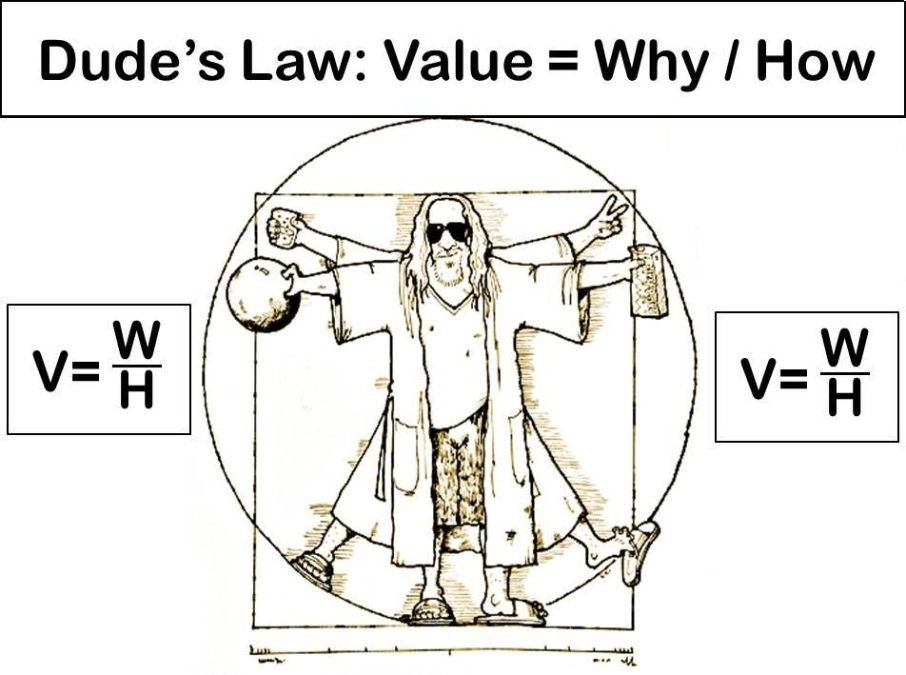
David Hussman distilled this into a fraction: Value = Why / How. The more purpose you have relative to your process, the more value you create. When value feels low, check the numerator before adding weight to the denominator. It’s a fast diagnostic for the output-activity trap: if you can’t explain the “why” in one sentence, more “how” won’t save you.
Why It Matters Now
Consider the build-measure-learn loop: historically, experiments requiring software development yielded the highest fidelity feedback but were the most expensive step. Dedicated craft time, collaboration, handoffs; all of it added process.
AI prototyping tools have radically accelerated this cycle. Functional, throwaway experiments are cheap and fast enough that the build step no longer constrains how quickly you can learn.
When building is cheap, you need less process around it. Simple workflows become viable where heavyweight ones used to feel necessary. If you’re not stripping process down to what actually earns its keep, your competitors are.
Resources
- David Hussman — “How ready are you to be wrong?” — Dude’s Law explained
- Cognitive Load — the underlying cost that every process step imposes
- Flow — what you’re optimizing for when you remove unnecessary process
- Continuous Everything — the delivery model that makes lightweight loops viable
- Small Slices of Value — the practice that pairs naturally with minimal process
- Outcomes Over Outputs — strengthening the numerator
- Trigger Words — words in software product development that make people feel some kind of way