 Knowledge
Outcomes Over Outputs
Shipping features is not the same as creating value. The gap between "we built it" and "it mattered" is where outcomes live.
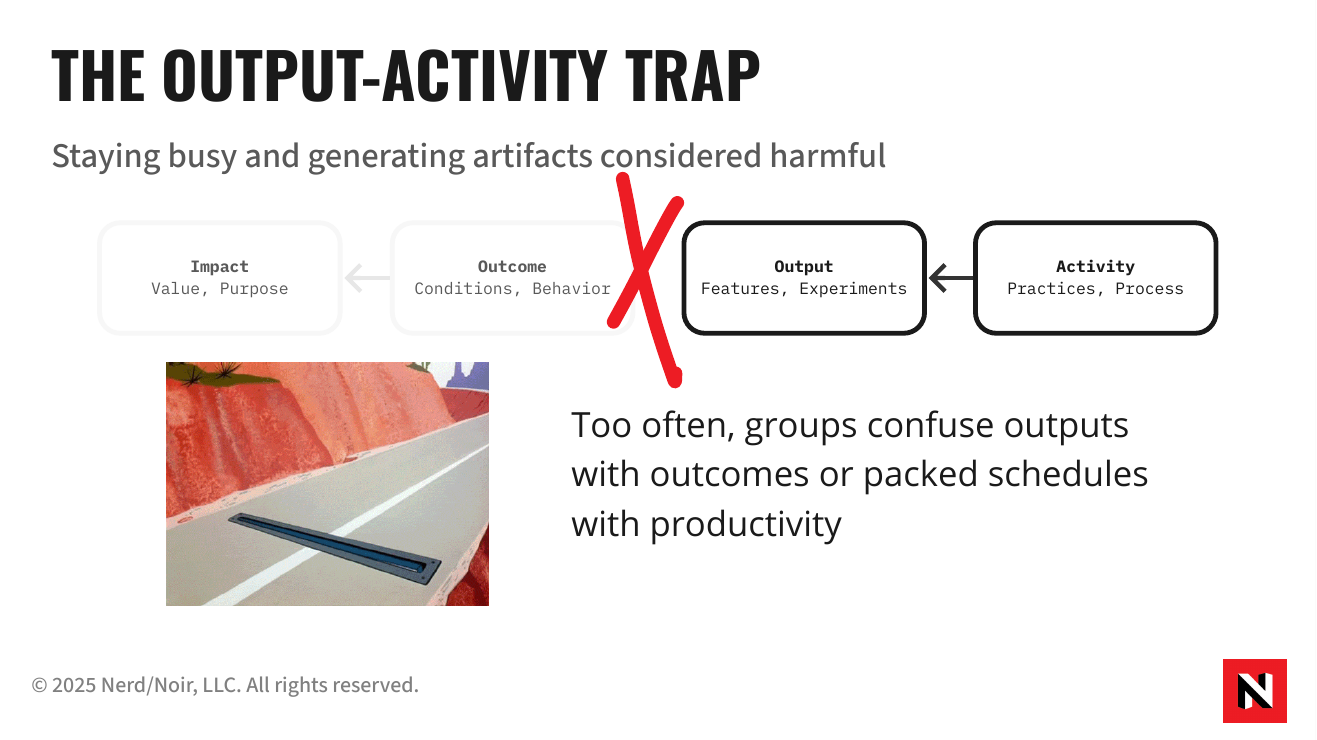
Outcomes are measurable changes in behavior, conditions, or system properties that follow from what a team ships. A team that builds a recommendation engine has produced an output; a team whose users find products 50% faster has achieved an outcome. Outputs are artifacts the team controls directly; outcomes are reactions in the world the team can influence but not command. A team can produce a steady stream of outputs without ever moving an outcome, which is exactly how feature factories happen.
Good outcomes share four characteristics. They’re Observable (we can measure them), Behavioral (someone or something changes), Valuable (they create business impact), and Testable (we can validate assumptions). In the Product Logic Model, outcomes sit between outputs and impacts in the causal chain, measured by leading indicators that give early signal while lagging indicators confirm impact over time.
Outcomes come in three types. User Outcomes measure behavioral changes (“New users complete onboarding 50% faster”). Customer Outcomes measure value delivered to the buyer, which in B2B is often not the user (“Hotel partners increase booking volume by 30%”). Technical Outcomes measure system improvements that enable future user or customer outcomes (“Improve uptime from 99.5% to 99.95%”). Balancing across all three prevents the adverse systemic effects of over-indexing on any single type.
Resources
- Joshua Seiden and Jeff Gothelf, Outcomes Over Outputs (Sense & Respond Press, 2019)
- Product Logic Model — the causal chain where outcomes connect outputs to impact
- Output-Activity Trap — the failure mode when outcomes are missing from the equation
- Outcome-Based Roadmaps — hands-on practice defining and roadmapping outcomes
- From Project Management to Product Strategy — a case study on shifting from project-driven delivery to outcome-focused product thinking