 Knowledge
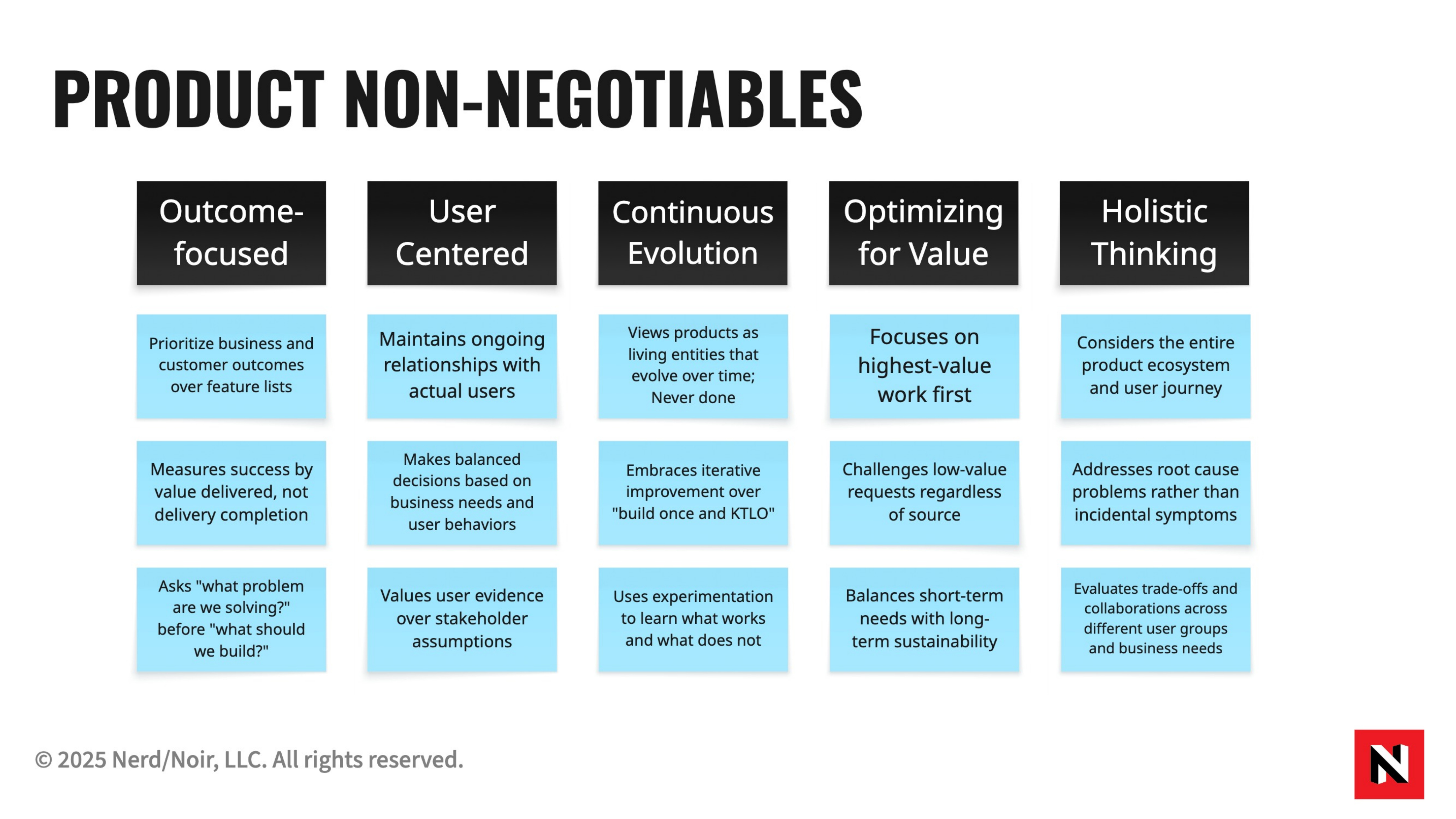
Product Non-Negotiables
These five pillars separate teams that build products from teams that take orders. Drop any one and you're running a feature factory with better branding.
The Product Non-Negotiables are five pillars that distinguish product-led teams from feature factories. They’re not aspirational values; they’re baseline expectations for how a product organization operates.
Outcome-focused. Prioritize business and customer outcomes over feature lists. Measure success by value delivered, not delivery completion. Ask “what problem are we solving?” before “what should we build?”
User Centered. Maintain ongoing relationships with actual users. Make balanced decisions based on business needs and user behaviors. No product decisions without evidence from real people using real software. Tools like Pragmatic Personas keep the team grounded in who they’re building for. Customer interviews and using your own product are the two most direct ways to stay connected.
Continuous Evolution. View products as living entities that evolve over time; never done. Embrace iterative improvement over “build once and KTLO.” Use experimentation to learn what works.
Optimizing for Value. Focus on highest-value work first. Challenge low-value requests regardless of source. Balance short-term needs with long-term sustainability.
Holistic Thinking. Consider the entire product ecosystem and user journey. Address root causes rather than incidental symptoms. Evaluate trade-offs across different user groups and business needs.
These pillars underpin the behavioral shifts taught in the Outcome-Based Roadmaps workshop: moving from accepting stakeholder requests as requirements to exploring underlying problems, from on-time delivery as success to measurable outcomes achieved, from large batch handoffs to small value chunks with continuous validation.
Resources
- Outcome-Based Roadmaps — where these pillars are introduced and practiced
- Product Logic Model — the causal model that operationalizes outcome-focused thinking
- What Product-led Means to Engineering — exploring the differences between project- and product-based engineers
- Your Requirements Suck — why crappy requirements are a symptom, not the problem